
The useful question is an ordinary one: if the site stops tomorrow, which day do you lose?
The answer is almost always one of the familiar places. The day the line made nothing. The day finished goods sat in the store and could not leave for the customer. The day raw material or ordinary packaging did not arrive. The day the only gate was shut, and nothing passed it: no vehicle and no shift.
The place without which that day goes to zero is what people call a single point of failure. In a published account of a small logistics company, that kind of day had already been counted: about 180,000 rubles. On a site the count is the same, tied to a particular place. How the sum is built is set out in the article on the cost of a day of downtime.
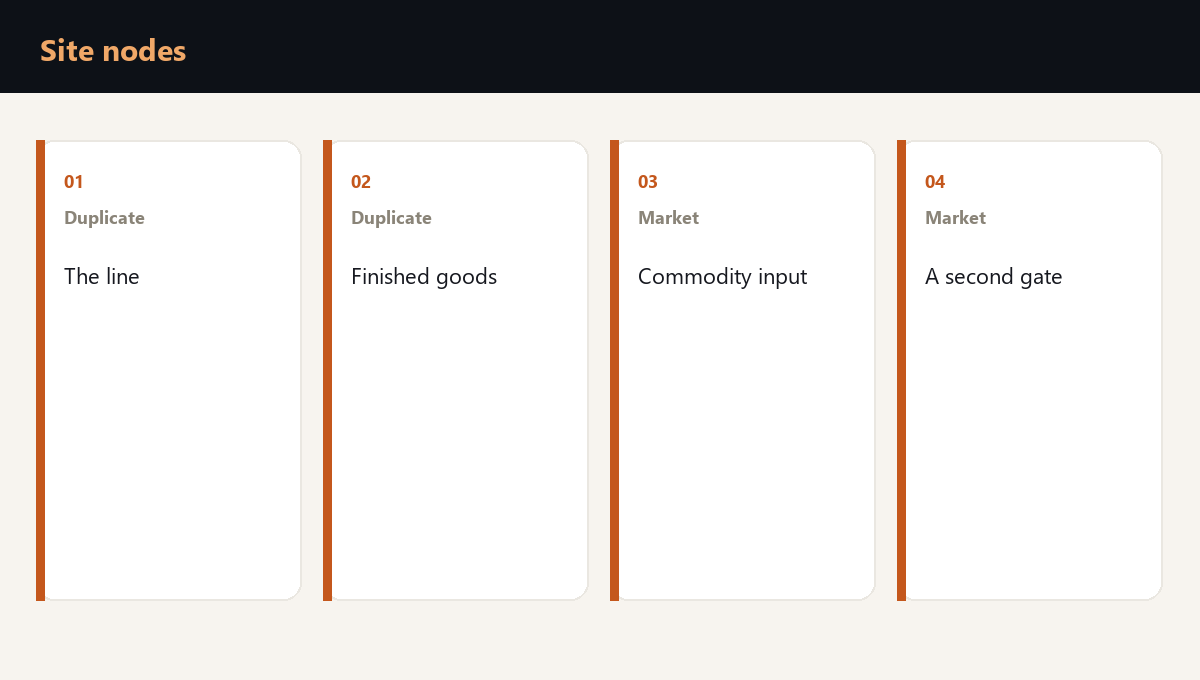
Which day disappears when this place stops
If the line stops, the plant makes nothing that day. An agreement on another route or another shift has to exist beforehand. That is a second way to make the same product, not a box of spare parts on a shelf.
If the finished-goods store is closed, the shop can still run, and the customer still receives nothing. That is why part of the finished goods is kept on a second site. A store next to the shop that has just stopped does not help on that day.
Material that is on sale every day, and ordinary packaging, can be bought again the next day. A hired shift can be found on the market too. A single gate is different: the whole site stands, because material cannot come in, finished goods cannot leave, and people cannot pass. A second gate is prepared before the event, not on the morning.
What can be bought the next day, and what the owner prepares
The market has plenty of commodity material, a standard carton and film, a store for rent nearby, and people for a shift. The loss here is measured in hours. A stock or a contract for a substitute brings the flow back.
A recipe, tooling, the only line with a long changeover, and the right to sign a shipment cannot be bought in a day. Neither can a store that carries one customer contract. Those are prepared in advance: duplicated, placed at another address, or handed to a second person on paper while the first person is still there.
- Bought on the market. Commodity material, ordinary packaging, a rented store, a hired shift.
- Prepared by the owner. Tooling, the recipe, the only line, the signature without which a vehicle does not leave.
- The owner test. If a place cannot be bought in a day, it has a pair somewhere else, and the cost of that day is written down before the event.
Where this map is counted for your site
The drone-attack readiness check lays the site out by these places, shows where the day stops completely, counts the cost of the downtime and of bringing output back, and writes down who stops the shift and who writes to the supplier.
A mesh or a canopy over the yard covers the first, physical step. The second step stays with the owner: the map of places, the cost of a day, and the decision about what to prepare in advance. Without that step the canopy is there, and the morning letter to the customer is not.
Frequently asked questions
With that site. The gate, the line and the store already coincide in one place. The map is there so you can decide what to separate first, while all three are still working.
A stock sits nearby and runs out. A second way lets you do the same work when the first way is unavailable, preferably at another address.
While the sum does not exist, there is nothing to compare a reserve with. In the logistics account the figure appeared before the next failure, and only then was it plain that there was no money set aside for that day.
Is your team ready for the first hour of a crisis?
You test a plan by running a scenario. Reading it is not enough. The assessment shows the gaps, and the corporate format works through them with your team on your own processes.