
After a strike on a site, insurance looks like the answer to what a stopped day costs. It is a different answer, and it does not arrive in the morning.
By morning the company already needs its own figure. In the published account of a logistics company, a day of that kind of downtime came to about 180,000 rubles, and there was no reserve for it before the sum was written down. The policy does not replace that note. It describes which interruption it recognises, from which hour it counts, and which documents it asks for. The payment comes after the documents. The company lives the day before that payment on its own.
What is worth reading in the policy beforehand
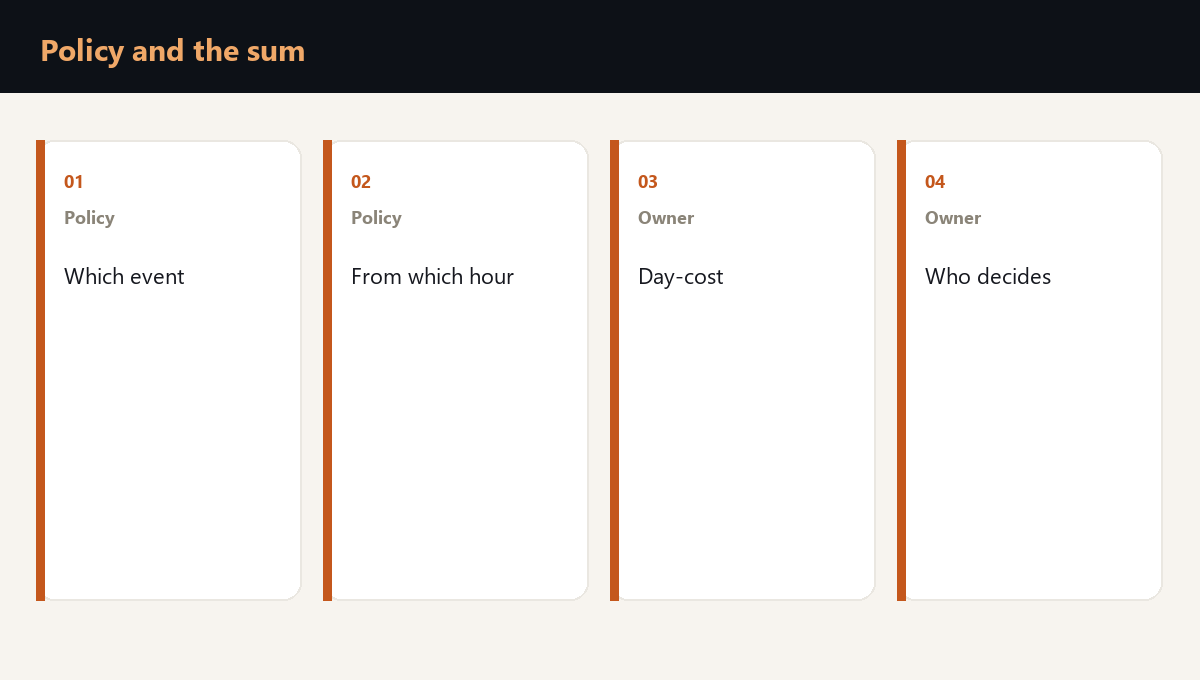
A policy text has several places that decide whether it is any use on the morning after a strike. Which event it recognises. From which hour it starts to count the downtime. Which documents it asks for, and whether the company can gather them while recovery is under way. Which exclusion crosses out this particular case.
Those answers are read next to the cost of the company own day, not in place of it. If an exclusion covers the very stop of the site, the policy is on the shelf and there is no payment for that day.
The count that stays with the owner
The owner counts the day the same way as in the article on the cost of a day of downtime: shipments not made, people and rent that continue, a penalty under the contract, and the cost of bringing output back.
Next to the sum, the owner writes which share of output can still be confirmed with documents if the line, the finished-goods store or the only gate is closed. That share is what the customer is told. The policy does not set it.
- The event. Whether a stop of the site is something the policy recognises.
- The hour. From which moment the policy starts to count the downtime.
- The documents. What has to be gathered, and who in the company does it.
- The share of output. What the company can still promise while there is no payment.
Where the policy and the count sit on one page
The drone-attack readiness check puts the policy wording and the owner count on one page: the cost of the day, the roles, the letter texts and the share of output that can still be confirmed.
A policy does not replace a plan. A canopy over the yard does not either. Both make sense after the owner knows the cost of the day and the name of the person who writes to the customer.
Frequently asked questions
No. The policy pays on its own wording and after its own documents. The count says what the day costs the company and what reserve it needs.
Which event is recognised, from which hour the count runs, which documents are required, and which exclusion can cancel the payment in this particular case.
The company. The decision is written down in advance, next to the name of the person allowed to say it.
Is your team ready for the first hour of a crisis?
You test a plan by running a scenario. Reading it is not enough. The assessment shows the gaps, and the corporate format works through them with your team on your own processes.